
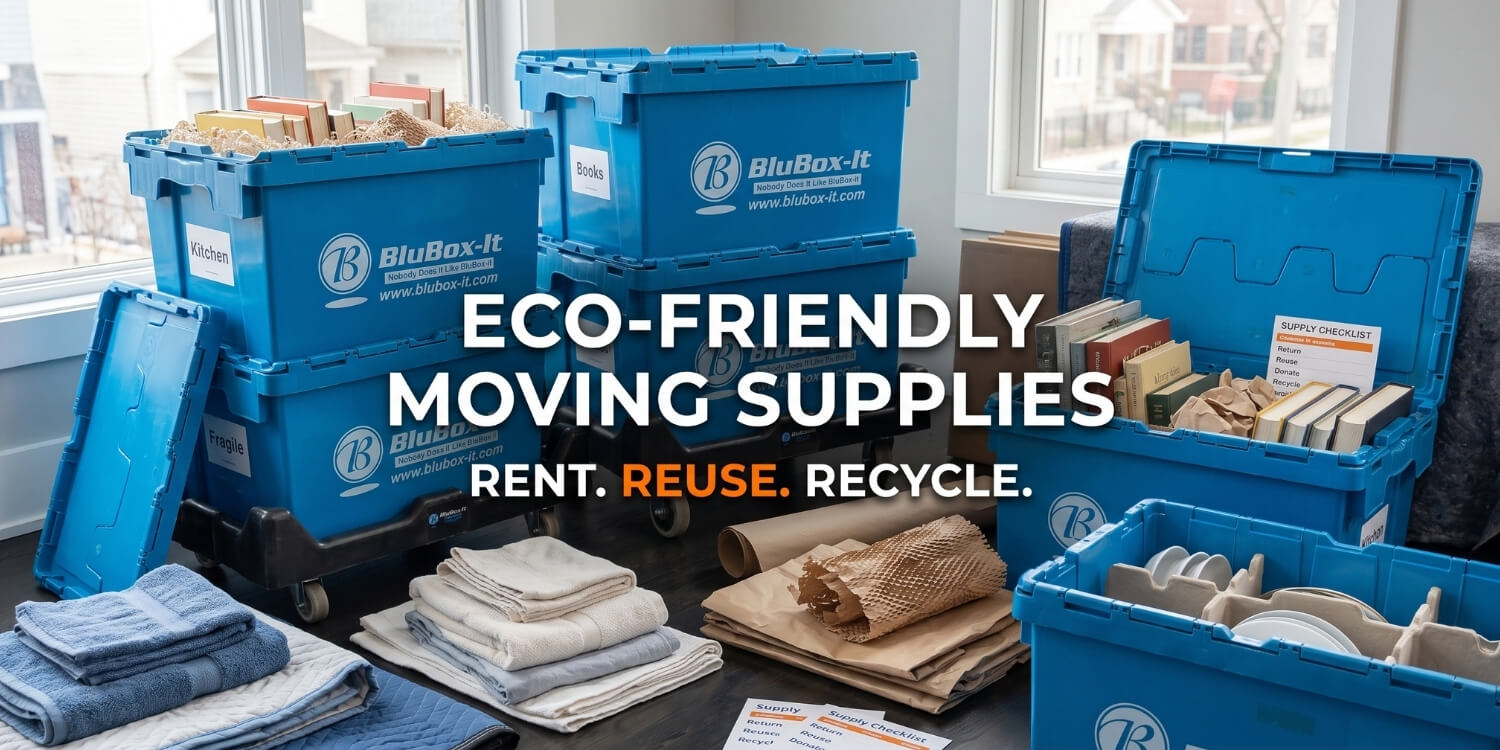
Most people do not need to buy an entirely new set of “green” packing products to make a move less wasteful. Start with the things that can already do the job safely: sturdy boxes you have saved, suitcases, laundry baskets, towels, blankets, or reusable moving bins. Then buy only the cushioning or specialty protection your belongings actually need.
The best choice is not always the product with the strongest environmental claim on the package. A reused cardboard box may be perfectly suitable for bedding, while dishes need a sturdy container plus enough wrapping and separation to keep pieces from hitting each other. Electronics may be safest in their original packaging. Bubble cushioning can still make sense for a delicate item if you reuse it instead of wrapping everything in plastic.
The practical goal is simple: use less material without increasing the chance of damaging what you are moving.
This guide explains what is worth renting, what you can reuse from home, where paper-based materials work well, when plastic protection is still useful, and what to do with supplies after the move.
What Eco-Friendly Moving Supplies Do You Actually Need?
A lower-waste packing setup usually needs fewer products than people expect. Think in terms of jobs rather than labels:
| Packing job | Practical options | What to watch for |
| Container | Reusable moving bins, sound reused cardboard boxes, recycled-content boxes, suitcases | Choose the right size and do not overload it |
| Surface protection | Packing paper, clean towels, linens, moving blankets | A soft layer may prevent scratches but not absorb a hard impact |
| Cushioning | Crumpled paper, honeycomb paper, bubble cushioning, molded pulp | Use the amount the item actually needs |
| Separation | Cardboard dividers, dish cells, paper layers, fitted inserts | Especially important for glassware, dishes, and framed items |
| Closure | Attached bin lids, paper or conventional packing tape, reusable straps | The closure must be strong enough for the load |
| Labeling | Paper labels, removable labels, markers, reusable label sleeves | Labeling helps handling but does not replace proper packing |
That distinction matters. A material that works well for one job may be poor at another. Packing paper can protect a plate from rubbing against the next plate, but a loose stack can still break if it moves around inside the container.

1. Use What You Already Own Before Buying More
The easiest way to reduce packing waste is often to avoid creating new demand in the first place. Before shopping, look around your home for materials that can safely do the same job.
Suitcases are useful for clothing, shoes, and linens. Laundry baskets can carry lightweight household items. Clean towels, blankets, T-shirts, and pillowcases can protect cookware, lamps, and sturdy decorative items. Original electronics packaging is especially valuable because the inserts were designed for that exact product.
The key word is safely.
Do not force a household item into a job it cannot perform. A laundry basket with an open top is not a good container for breakable dishes. A rough towel should not be wrapped directly around a polished surface that scratches easily. A weak shipping box should not be trusted with heavy books just because it is free.
This is where a lower-waste approach becomes practical rather than ideological: reuse what already works, but do not sacrifice appropriate protection just to avoid purchasing a small amount of the right material.
2. Choose the Container for the Item, Not for the “Green” Label
The container is the structure of your packing system. The right choice depends on what you are packing, how heavy it is, whether it is fragile, how long it will stay packed, and how the load will be carried and stacked.
Reusable Moving Bins
Reusable moving bins are useful for many household and office items because they are rigid, stackable, and ready to pack without assembling a cardboard box. A rental system also allows the same containers to move through repeated customer rentals instead of leaving each household with a new stack of empty boxes.
A rigid bin does not remove the need for internal protection.
If plates can knock into one another inside the bin, they can still break. If a computer monitor has room to slide, the hard outer container does not solve the problem. Think of the bin as the structure, then add only the wrapping, dividers, or cushioning the contents require.
For people using reusable totes, BluBox-It’s existing packing tips for moving totes guide can handle the deeper questions around weight distribution, space use, and labeling rather than repeating those instructions here.
Reused Cardboard Boxes
A used cardboard box can be a sensible option when it is still strong.
Check the bottom seams, corners, and walls before packing. Reject boxes that are crushed, damp, oily, torn, pest-damaged, or carrying a strong odor.
Box size matters just as much as box condition.
Books become heavy quickly, so smaller containers are easier to control. Bedding and pillows can go in larger boxes because they are bulky but light. Using an oversized box for dense items often creates an awkward load and encourages people to add unnecessary filler.
BluBox-It already has a dedicated comparison of cardboard boxes versus plastic moving crates, so this article should not repeat that entire debate.
Specialty Boxes and Original Packaging
Sometimes the lower-waste choice is not the most minimal-looking option.
A wardrobe box can prevent clothing from being folded, unpacked, and repacked several times. A dish pack or divider system can reduce the amount of loose cushioning needed. A television box or original electronics packaging may protect a high-value item better than several layers of improvised material.
Preventing damage is part of waste reduction too.
Replacing a broken television, mirror, or appliance can create far more waste and cost than using a small amount of appropriate specialty protection.
3. Use Paper and Household Fabrics Where They Make Sense
Packing paper is one of the most useful materials in a move because it can perform several jobs. It can wrap dishes, separate stacked items, protect hardware, and fill small gaps.
Paper made with verified recycled content can also reduce demand for virgin material, although environmental claims should be specific rather than assumed from words such as “green” or “eco-friendly.” The FTC advises businesses to substantiate and properly qualify claims involving recycled content, recyclability, compostability, and similar environmental characteristics.
Honeycomb paper and corrugated paper wrap provide more structure than a flat sheet and can replace plastic cushioning in some applications. Cardboard dividers are useful when the main problem is item-to-item contact rather than impact from outside the box.
Household fabrics are another practical option.
Towels can separate cookware. Blankets can protect furniture. Socks can fill small gaps around sturdy items. Clothing can cushion non-fragile belongings that are already traveling with you.
But do not treat every paper or fabric product as interchangeable.
Newspaper ink can transfer to light fabrics and porous surfaces. Towels can be too bulky for small containers. Paper alone may not be enough for a delicate glass object that is likely to receive a hard impact.
4. Add Cushioning Only Where the Risk Justifies It
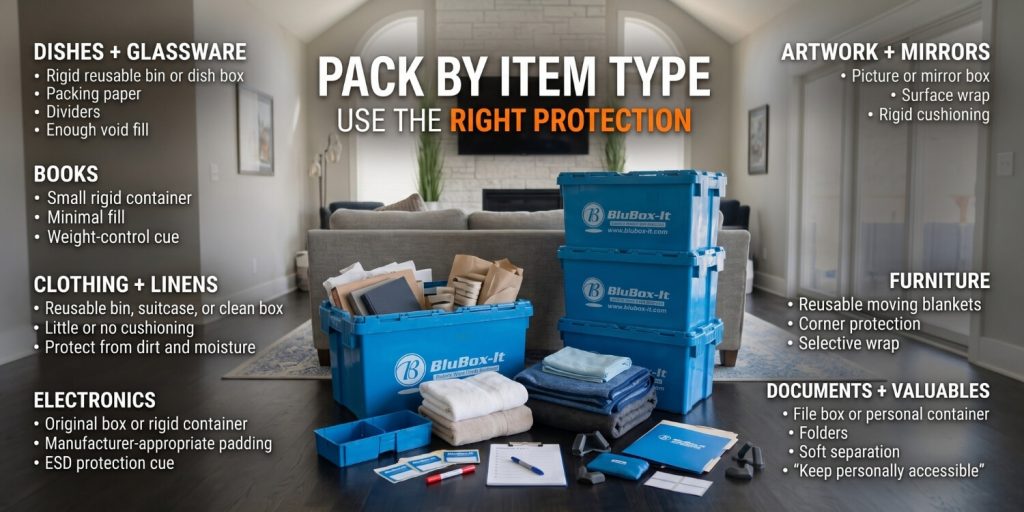
One of the easiest ways to overpack is to use the same cushioning in every container.
Different belongings have different risks.
Dishes and Glassware
The main problems are contact and movement.
Wrap pieces individually where necessary, use dividers when they help, cushion the bottom and top of the container, and fill enough empty space to prevent the contents from shifting.
A rigid bin or strong dish box provides structure. The wrapping and dividers solve a different problem inside that structure.
For detailed wrapping instructions, use the separate BluBox-It guide on packing fragile items safely rather than duplicating those steps here.
Books
Books usually need very little cushioning.
The bigger problem is weight.
A large tote filled completely with books can become harder to carry safely than two smaller loads. This is a good example of why “fill every container completely” is not always good packing advice.
Clothing and Linens
Folded clothing, bedding, and towels often need almost no disposable cushioning.
Clean reusable bins, suitcases, wardrobe boxes, or sound cardboard boxes are usually enough.
This is also where materials already being moved can do double duty. Bedding does not need to be wrapped in another disposable product simply because it is going into a moving container.
Electronics
Original packaging is often the best option when you still have it.
The inserts were designed to hold that particular product in position, which can eliminate the need to improvise with multiple layers of new material.
Sensitive electronics may also require anti-static protection. Ordinary towels, paper, and standard bubble cushioning do not automatically provide electrostatic-discharge protection. The EOS/ESD Association recommends appropriate static-control packaging and materials for ESD-sensitive products.
Artwork and Mirrors
Use corner protection, rigid support, and a correctly sized picture or mirror box when the item warrants it.
For unusually valuable, antique, oversized, or delicate pieces, professional packing may be the sensible choice. Trying to save one specialty box is a poor trade if the alternative is damaging a difficult-to-replace item.
Furniture
Reusable moving blankets and pads often do more useful work than wrapping an entire furniture piece in layers of disposable material.
Add stretch film or another securing material only where it is actually needed to keep the protection in position. Avoid placing film directly against a delicate finish when the material could trap moisture or affect the surface.
5. Bubble Wrap, Plastic Film, Foam, and Packing Peanuts Are Not Automatically “Bad”
A lower-waste move does not have to be a plastic-free move.
The better question is:
Does this material solve a real protection problem, and are you using more of it than necessary?
Bubble cushioning can be useful for fragile, irregular, or impact-sensitive items. If you already have clean bubble wrap from previous deliveries, reuse it before purchasing more.
Foam can make sense around certain electronics or delicate objects. Stretch film can help keep a moving blanket in place or provide moisture protection in a specific situation.
What should be avoided is automatic use.
Wrapping every drawer, towel, plastic container, or sturdy household object in film does not make a move safer simply because more material was used.
Plastic film also needs realistic disposal planning.
It generally should not be placed into household curbside recycling unless the local program specifically accepts it. Chicago identifies plastic bags and film plastics as materials that do not belong in its residential Blue Cart program, so residents should check the city’s current recycling guidance before disposal.
Some qualifying plastic films have separate collection options, but the exact product and local program matter.
Do not assume: “It is plastic film, therefore the grocery store will recycle it.” Check first.
6. Be Careful With “Biodegradable,” “Compostable,” and Other Green Claims
Environmental terms are useful only when they tell you something specific.
A product can be plant-based without being accepted in your home compost pile.
A package can contain recycled material without being recyclable where you live.
A product can technically be recyclable while no practical collection program exists nearby.
| Label | What it actually tells you |
| Reusable | The item is designed or suitable to be used again. It does not tell you how many times it will actually be reused. |
| Recyclable | The material may be recyclable where appropriate collection and processing exist. |
| Recycled content | Some or all of the product was made using recovered material. Look for a specific percentage when available. |
| Compostable | The material needs particular composting conditions. Some products require a commercial facility. |
| Biodegradable | The material can break down under certain conditions, but the term alone does not tell you how or how quickly. |
| Plant-based | Describes the source of some material, not necessarily how the finished product should be disposed of. |
| Plastic-free | Tells you plastic is absent. It does not by itself prove better protection, recyclability, or lower overall impact. |
The FTC specifically warns marketers against broad, unqualified environmental-benefit claims and requires appropriate substantiation and qualification for claims such as recyclable and compostable.
For someone packing a household move, the takeaway is much simpler: Read the actual product instructions and check the disposal system available where you live.
7. Plan the End of the Move Before You Buy the Supplies
A material does not become sustainable simply because it can theoretically be recycled.
What actually happens after the move matters.
- Return rented equipment. Schedule pickup for rented bins, dollies, moving blankets, or other reusable equipment.
- Reuse what is still useful. Save sound boxes, clean packing paper, dividers, bubble cushioning, straps, and specialty packaging if you have a realistic future use.
- Share or donate clean supplies. A neighbor, community group, office, school, or another household preparing to move may be able to use them first.
- Recycle what the local program actually accepts. Keep cardboard and paper clean and dry and follow local requirements for film and mixed materials.
- Compost only materials suitable for the composting system available to you.
- Dispose of contaminated or incompatible material correctly. Putting something in a recycling bin does not make it recyclable.
EPA’s waste-management hierarchy places source reduction and reuse ahead of recycling because preventing waste in the first place is generally preferred to managing it afterward.
That makes the hierarchy useful for moving too:
Avoid unnecessary purchases → reuse what works → recycle or compost where appropriate → dispose responsibly when no suitable recovery option exists.
Readers who want the broader process beyond packing materials can continue to BluBox-It’s existing zero-waste moving guide.
8. What Should You Use for a Typical Household Move?
If you want the practical answer rather than another long shopping list, start here:
- Use sturdy containers that match the weight and fragility of what you are packing.
- Reuse suitcases, baskets, towels, blankets, and original packaging where they can do the job safely.
- Keep packing paper available for wrapping, separating, and filling small gaps.
- Use dividers or specialty boxes when items can damage one another.
- Reserve bubble cushioning, foam, plastic film, and other specialty products for belongings that genuinely need their protective properties.
- Label containers clearly so they are handled and unpacked correctly.
- Decide before moving day what will be returned, reused, donated, recycled, or discarded.
Once everything is packed, loading still matters.
A carefully wrapped item can be damaged if a heavy container is stacked on top of it or if the load shifts during transportation. That is where the separate BluBox-It packing and stacking guide should take over.
Using Reusable Moving Bins for a Chicago Move
If you would rather not buy, assemble, and dispose of a large number of cardboard boxes, reusable-bin rental is another option.
BluBox-It provides reusable moving bins for Chicago-area residential and commercial moves and collects the bins after the rental period. Its current packing-supplies page also lists packing paper, bubble wrap, wardrobe boxes, dollies, and zip ties.
BluBox-It states that its rental bins are cleaned and inspected before returning to circulation. Even with a rigid reusable container, fragile and high-value belongings still need the appropriate internal protection.
The useful rule remains the same:
Start with the container, then add only the cushioning or specialty protection the contents actually require.
View Reusable Moving-Bin Packages
Frequently Asked Questions
What are the most eco-friendly moving supplies?
There is no single best material for every move. A practical lower-waste setup usually combines things you already own, reusable or rented containers, paper-based wrapping and cushioning where appropriate, and limited specialty protection for belongings that genuinely need it.
Are reusable plastic moving bins better than cardboard boxes?
Each can make sense in different situations. Reusable bins are rigid, stackable, and can circulate through repeated rentals. Cardboard is lightweight, widely available, and recyclable in many programs when clean and dry. The better choice depends on how the container will be used, reused, returned, stored, transported, and eventually handled after the move.
What can I use instead of bubble wrap?
Packing paper, honeycomb paper, corrugated wrap, molded-pulp inserts, towels, linens, and reusable moving blankets can replace bubble cushioning in some situations. They are not universal substitutes. Fragile, high-value, moisture-sensitive, or impact-sensitive items may still need specialized protection.
Can moving boxes and packing paper be recycled?
Clean, dry cardboard and plain paper are commonly accepted by recycling programs, but local rules vary. Wet, greasy, heavily contaminated, laminated, or mixed-material products may not be accepted. Reuse good materials before recycling them when practical.
Do I still need packing supplies if I rent reusable moving bins?
Usually, yes. The bin provides the outer structure, but fragile belongings may still require packing paper, dividers, bubble cushioning, specialty inserts, or other protection to stop movement and prevent contact.
How can I reduce plastic without increasing the risk of damage?
Use paper and household textiles for the jobs they handle well, reuse existing plastic cushioning before buying more, and reserve film, foam, and bubble cushioning for belongings that genuinely need those protective properties. The goal is to remove unnecessary material, not to ban one material regardless of what is being packed.